Valentine
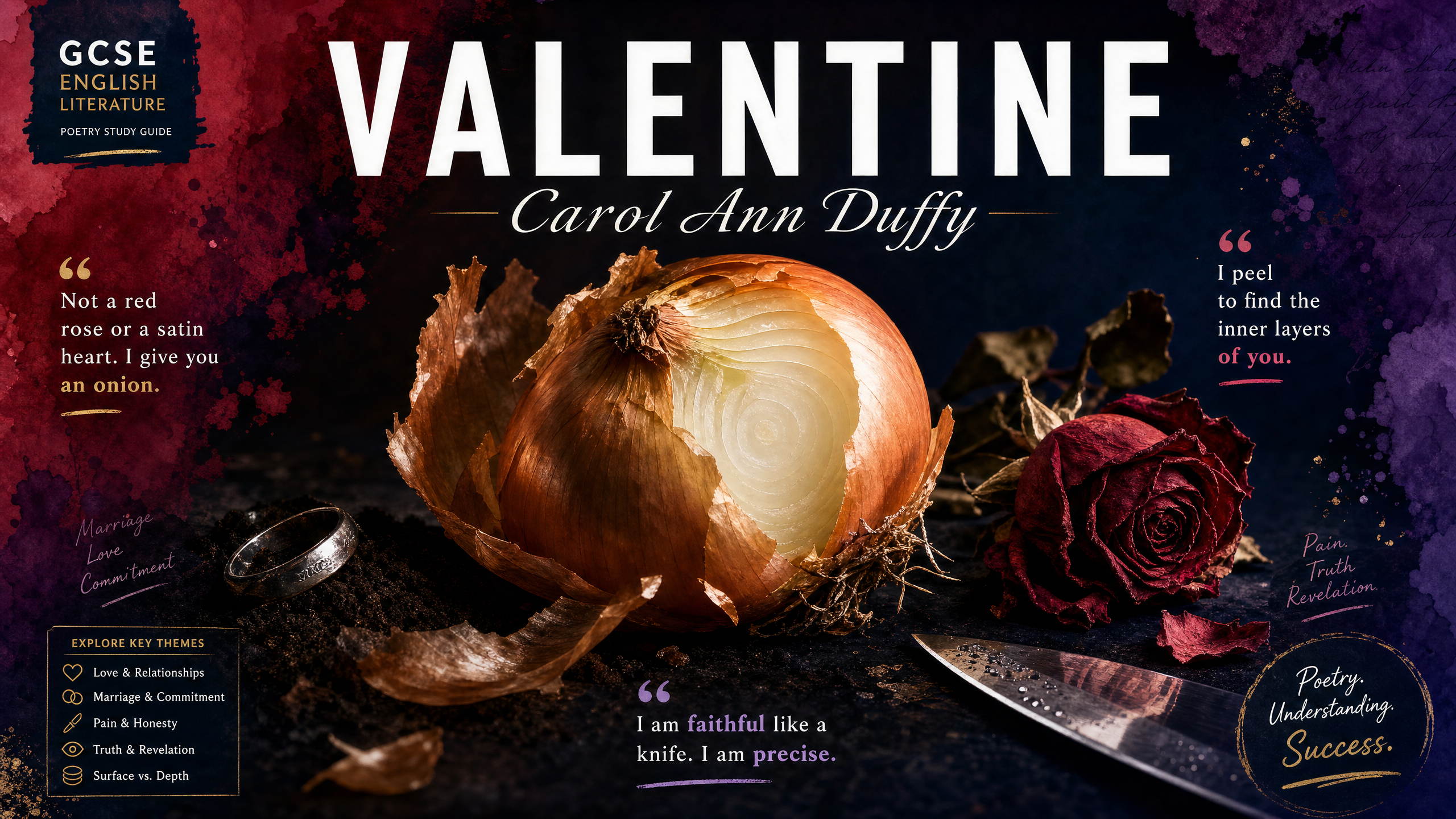
Carol Ann Duffy's 'Valentine' is a brilliant subversion of traditional romantic poetry. By offering an onion instead of a 'red rose or a satin heart', Duffy challenges us to consider love as something raw, honest, and potentially painful, making it a deeply rewarding text for AO2 (writer's methods) analysis.
Study Notes
Overview
'Valentine', published in Carol Ann Duffy's 1993 collection Mean Time, is a dramatic monologue that radically subverts our expectations of love poetry. Instead of conventional romantic gifts, the speaker offers their lover an onion. This central conceit (extended metaphor) allows Duffy to explore love in all its complex reality — not just its tenderness, but its possessiveness, its capacity to cause pain, and its enduring nature. For examiners, this poem is a goldmine for AO2 (analysis of writer's methods). High-scoring candidates will move beyond simply identifying the onion metaphor to analysing how the poem's structure (short, fragmented stanzas) and shifting tone (from intimate to threatening) reinforce its argument about the reality of modern relationships.
Listen to the Podcast
Before diving into the text, listen to our 10-minute deep dive into 'Valentine', covering core concepts, exam tips, and a quick-fire recall quiz:
The Central Metaphor
Theme 1: Honesty vs. Cliché
Duffy immediately establishes a conflict between conventional, commercialised romance and authentic love. The poem is an argument for truthfulness in relationships, rejecting superficial symbols in favour of something raw and real.
Key Quotes:
- "Not a red rose or a satin heart." - [The negative opening immediately subverts expectations. Duffy rejects these symbols as empty clichés.]
- "I am trying to be truthful." - [This single-line stanza is the structural and thematic pivot of the poem. It strips away the metaphor momentarily to state the speaker's core intention directly.]
- "Not a cute card or a kissogram." - [The harsh alliteration (c/k sounds) emphasizes the speaker's contempt for commercialised romance.]
Theme 2: The Complexity of Love (Tenderness and Pain)
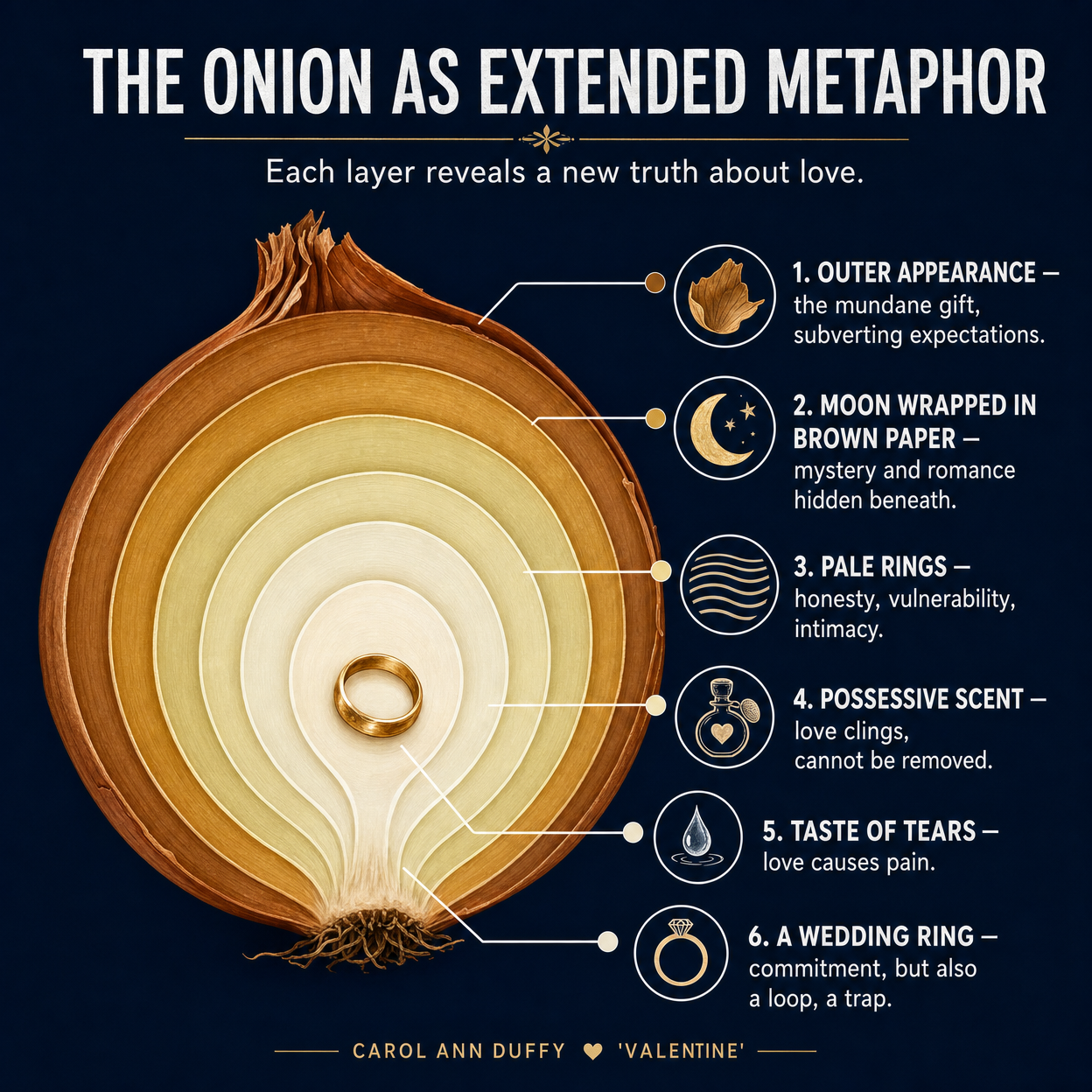
The onion metaphor is used to show that love is multifaceted. It has layers, it brings light and intimacy, but it also causes inevitable pain.
Key Quotes:
- "It promises light / like the careful undressing of love." - [The enjambment creates a pause that mirrors the gentle, hesitant vulnerability of physical and emotional intimacy.]
- "It will blind you with tears / like a lover." - [The sensory imagery of the onion's physical effect is mapped onto the emotional pain love causes. The simile acknowledges that pain is an inherent part of authentic love.]
Theme 3: Possessiveness and Entrapment
As the poem progresses, the tone darkens. Duffy explores how love can become suffocating, possessive, and inescapable.
Key Quotes:
- "Its scent will cling to your fingers, / cling to your knife." - [The repetition of 'cling' creates a sense of claustrophobia and possessiveness. The 'knife' introduces an overtly threatening element.]
- "Its platinum loops shrink to a wedding ring" - [The onion rings represent commitment, but the verb 'shrink' suggests constriction, entrapment, and loss of freedom.]
Tone and Structure
Writer's Methods
Form: The poem is a dramatic monologue, written in free verse. The lack of a regular rhyme scheme or meter reflects the poem's rejection of traditional, predictable romance. It sounds conversational, direct, and authentic.
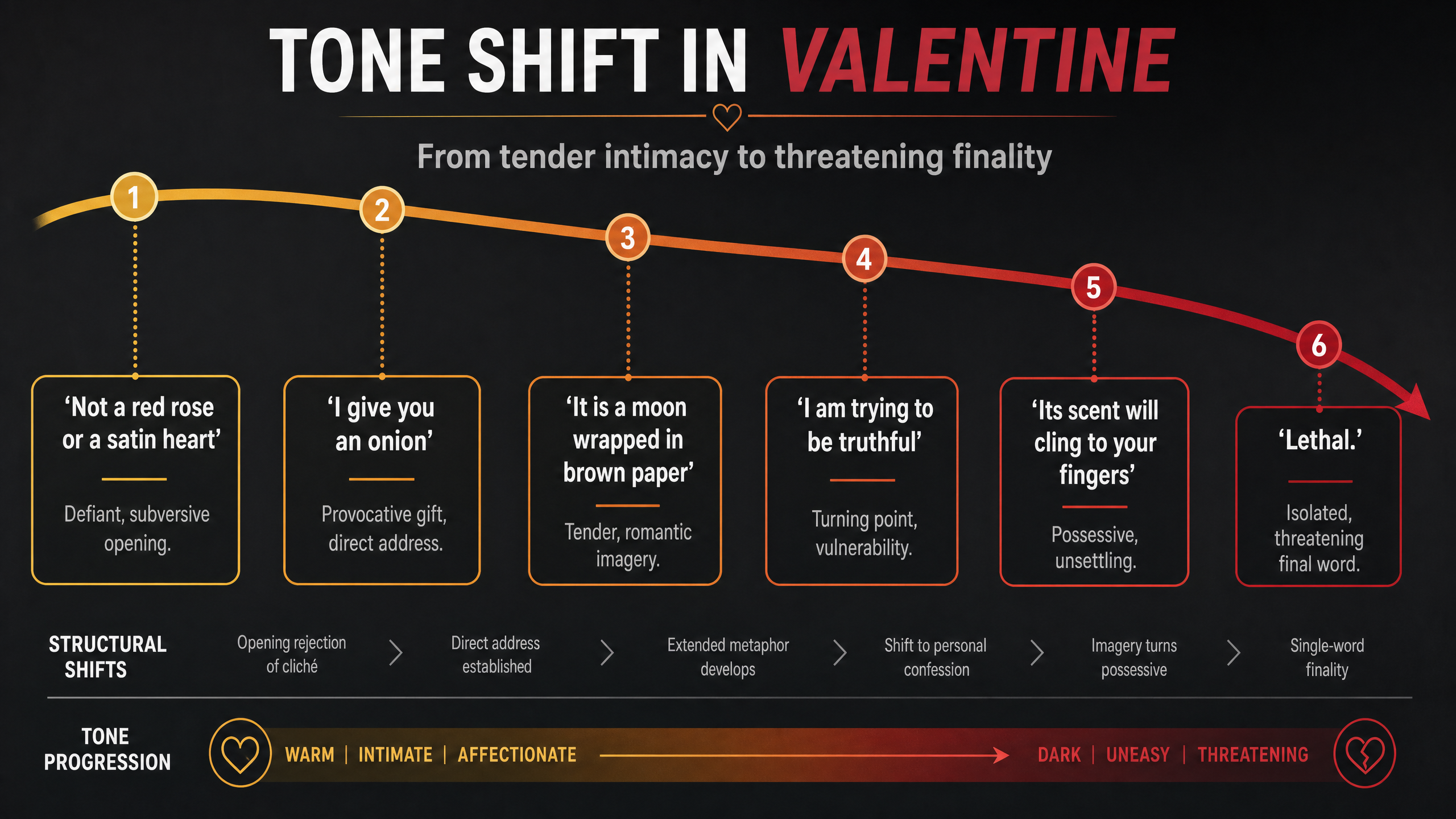
Structure: The stanzas are irregular, often very short, and sometimes consist of just a single line (e.g., "Here.", "Lethal."). This fragmented structure mirrors the peeling of an onion — layer by layer, revealing stark, unadorned truths. The isolation of the final word "Lethal." gives it massive structural weight, leaving the reader with a lingering sense of threat.
Language: Duffy uses direct address ("I give you", "It will blind you"). This creates an intense intimacy between the speaker and the addressee (and by extension, the reader). The language shifts from the romantic ("moon wrapped in brown paper") to the domestic ("onion") to the violent ("knife", "Lethal").
Context (AO3)
Carol Ann Duffy, appointed Poet Laureate in 2009, often writes from a feminist perspective, giving voice to marginalized figures or challenging patriarchal norms. In 'Valentine', she challenges the traditional power dynamics of romantic poetry. Historically, women were often the passive objects of male romantic praise (like the 'red rose'). Here, the speaker is active, assertive, and dictating the terms of the relationship. Furthermore, the poem reflects a modern, late-20th-century skepticism towards the commercialisation of holidays like Valentine's Day.
Interactive Diagrams
1 interactive diagram to visualise key concepts
Conceptual Flow Outline
Structural and Tonal Progression in 'Valentine'
Worked Examples
1 detailed example with solutions and examiner commentary
Practice Questions
Test your understanding — click to reveal model answers
Explore how Duffy presents the dark side of love in 'Valentine'.
Hint: Focus on the second half of the poem: the tears, the clinging scent, the shrinking ring, and the knife.
Compare how Duffy presents romantic relationships in 'Valentine' with how relationships are presented in one other poem from your anthology.
Hint: Choose a poem that either contrasts with Duffy's realism (e.g., a highly romanticized poem) or shares her focus on possessiveness/pain.
How does Duffy use structure to enhance meaning in 'Valentine'?
Hint: Look at stanza lengths, line breaks (enjambment), minor sentences, and the final word.
Explore the significance of the onion metaphor in the poem.
Hint: Track the metaphor from the beginning to the end. How does it change?